Friday, August 26, 2022

Taiwan Stores on Wheels

Now, this is a great business model for both owner and customer.

A brick and mortar shop, well, more specifically, sheet metal and rubber, general store on wheels. Almost online shopping, rolling through the neighbourhood, right to your front door.

Taiwan is filled with little businesses whose retail space, customer shipping and home delivery service is a mini Japanese truck. The bed behind the cab is converted into different configurations to hold products from pineapples to sheets of plate glass.

One mobile shop sells household goods and cruises through neighbourhoods regularly, motoring slowly. A recording blares from an ancient public address speaker bolted to the cab roof. From a distance, neighbours know what’s coming. Customers step out of their rows of townhouses into the street to shop roadside. 

little general store - what do you want?

Products hang and swing from every spare space. Huge bright orange plumes from feather dusters blow in the breeze. Goods are bungee cord-secured in place and shoppers can place special orders for future deliveries. It’s like Amazon.

This shop has aluminum step ladders, potting soil, brushes, brooms, mops, garbage bags, mats and more. You need concentration to identify everything and see what you might need. If you can’t locate it, ask because stuff gets buried under piles of toilet plungers. 

open for business in a neighbourhood

                                                                     ***

Other tiny motorized shops sell different merchandise and services. An A-frame rack on the back of one truck advertises window repair. It is layered with sheets of glass. Some pieces are picture window size, and others are thick - embedded with mesh. Another section of the rack has coloured and textured glass. Its pa speaker blasts the streets too.

Another entrepreneur specializes in window screen repair. The truck bed is filled with plastic sections of screen, bundles of screen, and even rolls of metal fencing. You pick your product, the driver installs the bug barrier, and the speaker continues down the street.

Keep an ear open for your favourite travelling store and remember to check under the plungers. 

Thursday, June 30, 2022

Paving Crew

A paving crew put down a fresh liquorice-black ribbon of asphalt on the street 
by my school. No one knew they were coming.

By 8:30 am, curbside cars were carefully raised by forklift and gently placed 
on the sidewalk. Male and female construction workers in flip-flops and rubber boots 
tore up cracked tarmac chunks, graded and spread clean black-tar icing.
Some workers wore bamboo farmer hats while others wore hard hats.
Some were barefoot.

White chalked string snapped straight lines for painting.
Parking spaces, crosswalks and instructions were needed.
Green, red and white cream-glaze paint went down.

By afternoon, the yellow forklift gingerly placed the cars back on the street.

But two workers discussed a BMW – their yellow hard hats together.
It was hoisted again and repositioned 12 inches closer to the curb.
Then a perfect white rectangular box was painted around it.

Friday, June 24, 2022

Fly Fishing a Concrete Stream

The tiny artificial fly flutters like a dandelion seed and then gently settles close to a section of softly spilling water.  I’m casting a minute 5mm fly into a pool on a hillside stream. It’s late afternoon, and the fly imitates a midge or mayfly, winged aquatic insects emerging on the surface.

To imagine the fly’s landing location and make it happen takes much of my brainpower - an immersion. Pictures of the process flash still frames through my brain. Pulling the line off the water, back swing and some line let out, forward swing, more line added. The final back and forward cast are automatic because the fly’s destination is fixed in my head. 

Casting blocks everything except tumbling water and the metronome rhythm of the fly rod and line. I think that’s part of why I enjoy fly fishing. It’s not just watching nature but participating in nature. 

I’m pleasantly surprised when my fly lands next to the veil of water flowing over the modest waterfall rim. My skills are limited, but the fly line unrolls like a tossed coil of firefighter’s hose and settles bullseye. A jolt of satisfaction passes through me like a final puzzle piece snapped into place.

The water’s surface tension and light feather-fur fibers keep the fly afloat. The fly swishes slightly, side to side. I watch the tiny vertical tuft of yarn for a strike.

                                                                   ***

I’m in Dakeng, again, Taichung City’s eastern hills, which are filled with steep streams. I’m fly fishing a terraced stream with check dams interspersed down its length. Taiwan is primarily mountainous and combined with typhoons and heavy rains, some rivers have the greatest natural material discharge in the world. 

Dakeng’s streams are filled with simple blocks of poured concrete placed in rows across the streams. Each check dam retains rock and soil that washes downstream during rain.

After decades of natural erosion, the check dam edges are rounded and pebbly. The dams’ concrete colours have changed, softened, and blended to create a series of low terraced waterfalls down the hillside, each with a plunge pool below. The fish hold up around the pools. 

low check dams terrace the stream

clear concrete pool

The Fragrant Red karaoke restaurant owner, next to my stream, is sweeping up leaves. The acre surrounding his restaurant is filled with towering hardwood trees. Along with his wooded restaurant: farms, orchards, bushes, and forest line the stream edge. The area is tranquil. 

I roll up next to the boss and ask the stream’s name. He stops sweeping with his twig-broom and answers, “Keng Heng Xi.” Loosely translated, it means Big Valley stream.

The banks of Big Valley stream are concrete, but the streambed is left natural and filled with round rocks.  Tall grass and reeds sprout among the meandering channels. Jungle vegetation pours over the concrete sides that have gradually shifted in colour from white to grey to beige, olive-green or weathered earthen terracotta. The foliage softens and hides the artificial material.  


vegetation takes over the far stream bank

I park my scooter, grab my fly rod, and cling to thick bamboo trunks along a section of natural stream bank while heading down to the water. The water is cool on my sandaled feet as I crouch down, heading for the first pool. Dragonflies, the colour and texture of burgundy velvet, oscillate around me: their stained glass window wings blurred. Iridescent blue kingfishers patrol the stream like chubby darts with speedy wings. 

The check dam waterfall I’m approaching has rusted rebar rods protruding. The bars are bent round with wear. It’s strange, but in a stream, with such a huge human impact, my mind blocks out the man-made intrusions and focuses on the natural beauty flowing through and around artificial formations. It’s difficult to explain, but nature takes over.                                                                           

It’s just before sunset and multiple rings radiate from fish rising for bugs. Many aquatic insects hatch at sunrise and sunset. They float on the surface, preparing for liftoff.  I’m hunched over – nose to the stream surface.

I cast a few times, and fish rise, but no takers. The next pool is larger and deeper. It’s early summer, and the annual East Asian monsoons, or plum rains, have arrived. Kingfishers and egrets have feasted. I cast, and a fish rises gulps the fly and is soon to hand. It’s a small four-inch Taiwan horse mouth minnow. Big Valley Stream contains several species. Some near eight inches.

A hungry Taiwan horse mouth minnow 

Big Valley stream is a freestone stream and dependent on spring and summer rain. In June, southern China’s rain bustles over the stream’s smooth rocks. I slide over the side of a check dam. The pool below is deeper than anticipated, and water rises about my pockets. My cell phone holds its breath and survives.  The bills in my wallet are soaked. 

The water levels are high and murky. Fish are skittish in the low visibility. My tiny fly attracts another fish. I continue another 400 metres as the sun settles and long slender shadows push back from the tall grass. The day is almost done.

Small fish, but I’m not disappointed.  Next time, I might try a different fly or fish when water levels are lower and clearer. There is satisfaction standing in a heavily human-altered stream that still retains its natural character. On an island so dramatically transformed by human disruption, Big Valley stream carries on – bending rebar aside.

Tuesday, April 12, 2022

Beetlemania - An Insect Pet Store

Three pairs of pin-pointy claws gripped my fingers tightly. With its long Y-shaped cephalic horn, a four-inch male Rhinoceros beetle carefully advanced along my fingers.  It moved robotically. Deliberately and precisely placed its legs. With each step, the appendages contracted with equal pressure. Methodically moving up my hand, each barbed foot squeezed with an uncomfortable sharpness.

This encounter was years ago, during recess, at my old school. My grade two students had searched the deciduous tree-filled playground, proudly presented me with their treasure and insisted I hold it.

My eyes grew huge. My northern home country has nothing like this. I felt a near overwhelming instinct to flail and shake it off. An almost primordial fear even though they are harmless. A large insect crawling up my hand was both unsettling and fascinating. 

I couldn’t decide whether to scream or casually comment, “oh, that’s so cool!” But grit is required in school teachers of smiling seven-year-olds. So I held my terror in check and decided on the latter response.

                                                                 ***

Now, years later, I’m surrounded by hundreds of such beetles - many much larger than my playground friend. I’m in an insect pet shop in Taichung - immersed in a curious subculture. 

Beetles as pets and collecting beetles is big business. A passion and obsession for many.  Between beetles, beetle-related products, toys and games, combined annual sales in Taiwan run into the hundreds of millions of dollars.

Taiwan is an insect sweet spot. The island’s location and topographical characteristics make it a paradise for beetles and other insects. To date, over 6,200 species of beetles have been identified and catalogued. 

                                                                 ***

In this shop’s sparse 360 square feet, beetles are king but not the only tenants. Storefront window cases are filled with chameleons whose rotating periscope eyes follow me. The place is packed. Not an inch is bare. Insects, related creatures, and a few reptiles and amphibians are thrown in too.  

Hundreds of mounted beetles and other insects in huge wooden frames dominate the walls. Posters, pamphlets and nets fill the remaining space. Just looking and identifying everything takes time.


bugs to your right through the front door

The right-side wall is one continuous angle-iron shelf of supplies: the four different soil types for beetle larvae development are bagged ready to go, heat lamps, other bug necessities, and food. Dozens of small plastic aquarium-style containers are stacked high.

More containers hold tiny black spiders and a tall rectangular vivarium, a terrarium with animals, as one definition puts it, has hordes of praying mantas clinging to long branches. A praying mantis can rotate its head a full 180 degrees. No sneaking up on this bunch.

The left wall has creatures. Boxes of crawling crickets. More angle-iron shelves filled with scorpions stacked in containers like egg cartons in a supermarket fridge. The scorpions wait patiently. 
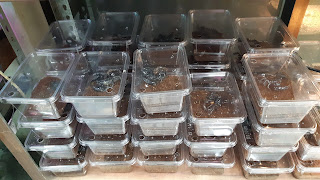
dozens of stacked scorpions 


Next to the scorpions are plastic boxes of beetles. Each container has a sticker with the beetle’s date of birth, sex and length. They contently sit on a layer of soil packed with moss and food cups. A long wide cabinet fills the central floor space between the two walls with additional provisions and mountains of more beetles.   

beetle fruit jellies in various flavours
                                                          

I inspect one giant rhino beetle and ask Michael the manager if it’s expensive. He answers, “not really. It’s old.”  Age, size, species, physical characteristics and body symmetry are all part of the price equation. Michael tilts his head and continues, “this one is about US$100.” Store prices range from approximately fifteen dollars to several hundred dollars. Online sites reveal much higher prices.

I ask where do the beetles come from. Michael proudly responds, “we raise them all here. None are from the wild.” I continue, “how many types do you have?” Michael stops opening beetle food cups, ponders the question, and answers, “too many to count.” Taiwan beetles are popular, but so are species from Thailand, Indonesia, Malaysia and the Philippines. 

                                                            ***

The store is compact, but the backroom extends the long, narrow building's length. I learn about a rhino beetle’s life cycle among heaps of supplies.

An employee hunched over a deep dirt tray carefully breaks apart chunks of soil, searching for beetle eggs. Meticulously, the pieces of earth are inspected, and the milk-white eggs, the size of kernels of corn, are gingerly removed with a long cocktail spoon and planted in another container. The eggs hatch in a week or two, and the larvae begin to grow in a nutrient-rich medium.  

Larvae develop over several months. When larvae have progressed sufficiently, customers make grub purchases, and as the larvae grow, owners return to have the soil changed to match the different stages of development.

                                                            ***

The story is bustling, and people arrive for supplies, to ask questions and visit. A woman with two small boys shows up clutching a bag. Michael removes a container and gently pulls out three large beetle grubs the size of stout German sausage links. The woman is concerned. Michael nods, places each larva on a digital scale, and writes down their weight in a spiral notebook. He replaces the old soil with fresh soil, returns the grubs carefully, and buries them. Beetle larvae don’t like to be disturbed.

Later I asked what happened. Michael replies, “the larvae were too small for their age. They should be bigger. They needed new soil.”  Beetle larva lounge around in the different soil mixtures for months and eventually emerge as adults and can live from about six months to nearly a year.

Both children and adults enjoy the hobby. Beetles are inexpensive and relatively easy to care for, so whole families participate. Many adult customers’ interest began as children and has continued for decades. As a child, the store owner Vincent went to the mountains hunting for beetles and has owned this shop for over 20 years.

Some enthusiasts breed and raise beetles. Michael comments that many beetle owners are serious collectors with extensive and expensive collections.

                                                            ***

Michael lifts a giant beetle from its container with care and holds it while I click pictures near the end of my visit. The beetle shines lacquered black. It calmly dangles and is soon returned to its home. 

I learn Michael doesn’t let beetles climb on his hands, citing beetle feet are too sharp. I’m relieved. At least here, there is little chance of screaming. 


an enormous beetle - not treading on anyone